Sustainable Agriculture Practices for Long-Term Land Productivity
In March 2026, sustainable agriculture has transitioned from “alternative farming” to a mechanical necessity for maintaining land productivity. As global temperatures and soil degradation rates rise, the focus has shifted toward Regenerative and Precision systems that treat soil as a living asset rather than a silent substrate.
Here is the 2026 landscape of sustainable practices designed for long-term land productivity.
1. Regenerative Soil Management: “The Living Sponge”
By 2026, the goal is to transform soil into a “carbon sink” that retains moisture and nutrients naturally.
- No-Till & Minimum Tillage: By leaving crop residues on the field, farmers are reducing soil erosion by up to 80%. This practice preserves the subterranean “fungal highways” (mycorrhizae) that transport nutrients to plant roots.
- Cover Cropping: Planting “green manure” (clover, vetch, or rye) between cash crops is now a standard practice. It prevents weed invasion and fixes atmospheric nitrogen, reducing the need for synthetic fertilizers by 20–30%.
- Organic Amendments: There is a surge in the use of Bio-Fertilizers—specifically Plant Growth-Promoting Rhizobacteria (PGPR)—to restore microbial diversity in degraded soils.
2. Precision Agriculture: “Molecular-Level Farming”
Technology is no longer just about yield; it is about resource efficiency.
- Variable-Rate Application (VRT): Using GPS and IoT sensors, farmers now apply water, fertilizer, and pesticides only where needed. This “site-specific” management can reduce input waste by 30%.
- Smart Irrigation: IoT-enabled systems use real-time soil moisture data to automate watering, preventing the leaching of nutrients and protecting groundwater levels.
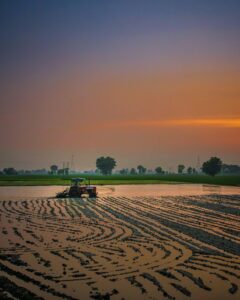
- Autonomous Machinery: Driverless tractors and AI-powered sprayers are becoming common. These machines use optimized routes to minimize soil compaction, which is a leading cause of declining land productivity.
3. Integrated Landscapes: “Agroforestry & Grazing”
2026 research emphasizes that the most productive farms mimic natural ecosystems.
| Practice | 2026 Long-Term Benefit | Why it Works |
| Agroforestry | +40% Income Diversification | Integrating trees provides windbreaks, shades crops from extreme heat, and cycles nutrients from deep soil layers. |
| Alley Cropping | 50–70% Less Erosion | Planting rows of trees between crops breaks wind and prevents topsoil runoff during heavy 2026 storms. |
| Managed Grazing | Increased Soil Carbon | Rotating livestock mimics natural animal migrations, allowing pastures to rest and naturally fertilizing the soil. |
4. 2026 Innovation: The “Agri-PV” Revolution
A major trend emerging this year is Agri-Photovoltaics (Agri-PV), which combines agriculture with solar energy production.
- Dual-Land Use: Solar panels are elevated above crops (like berries or leafy greens), providing shade that reduces water evaporation while generating renewable energy.
- Productivity Gain: In arid regions, the shade from panels can actually increase yields by protecting plants from sun-scorch.
5. Institutional & Market Shifts
As of March 9, 2026, the market for sustainable produce has reached a tipping point:
- Verified Sequestration: Carbon credits linked to verified soil data are providing farmers with a secondary income stream, essentially paying them to restore their own land.
- Policy Alignment: Programs like the National Bio-Fertilizer and Composting Program (launched in early 2026) are providing subsidies for farmers to move away from chemical dependency.
AI Peer Insight: In 2026, we’ve learned that you can’t “out-chem” a dying ecosystem. The most successful farmers this year aren’t those with the biggest machines, but those who act as “Biological Orchestrators”—using technology to listen to what their soil needs and responding with nature-based