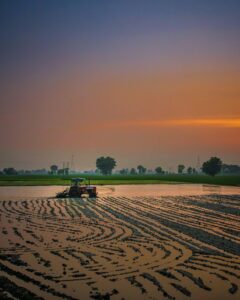
Smart Irrigation Systems for Efficient Land and Water Use
In March 2026, Smart Irrigation has transitioned from a sustainability goal to a core financial strategy for global and local agriculture. As of today, March 9, 2026, the global smart irrigation market is valued at approximately $2.44 billion, driven by the urgent need to optimize the 70% of freshwater that is currently consumed by the agricultural sector.
In Pakistan, the launch of the Punjab Smart Irrigation System Scheme 2026 represents a landmark shift, offering subsidies to farmers to move away from wasteful flood irrigation toward high-efficiency, sensor-driven systems.
1. The Architecture of 2026 Smart Systems
Modern smart irrigation is defined by a “Closed-Loop” architecture where data from the field automatically dictates mechanical action.
- The Sensing Layer: In 2026, systems utilize Multi-Depth IoT Sensors. These don’t just measure surface moisture but track the “Root-Zone Reality” at various intervals (e.g., 10cm, 30cm, and 60cm). This prevents the common mistake of overwatering the surface while the deep roots remain dry.
- The Decision Layer (AI Tutors): Platforms like Jeevn AI and Farmonaut now use “Digital Twin” technology. They simulate your specific field’s hydrological balance using satellite-derived Evapotranspiration (ET) rates and local weather forecasts to predict water needs 48 hours in advance.
- The Actuation Layer: Smart solenoid valves and variable-speed pumps execute these decisions. In 2026, even small-scale farmers are adopting Arduino-based auto-watering kits, which can reduce water usage by up to 50% for a fraction of the cost of industrial systems.
2. Variable Rate Irrigation (VRI): Centimeter Precision
One of the most significant advancements this year is the democratization of Variable Rate Irrigation (VRI). Instead of applying a uniform “blanket” of water, VRI treats a single field as a collection of unique micro-zones.
| VRI Type | Mechanism | 2026 Application |
| Speed-Control | Adjusts the travel speed of center-pivots. | Best for broad changes in field elevation. |
| Zone-Control | Groups sprinklers into specific management zones. | Ideal for fields with mixed soil types (e.g., sandy vs. clay). |
| Nozzle-Level | Controls individual sprinklers independently. | Used for high-value specialty crops and irregular field shapes. |
3. Local Focus: The Pakistan Transformation (March 2026)
As part of the Agriculture Transformation Plan 2026, the Punjab government is aggressively modernizing the province’s irrigation infrastructure.
- Subsidized Modernization: The new scheme provides financial assistance for Drip and Sprinkler systems, which deliver water directly to the plant base, increasing fertilizer efficiency (fertigation) and reducing electricity costs for pumping.
- LIMS Advisory Reports: Since its inception, the Land Information and Management System (LIMS) has generated over 700,000 farm-specific reports, helping farmers in districts like Faisalabad and Multan time their irrigation to avoid waste during heatwaves.
- Canal Smart Monitoring: Beyond the farm gate, “Smart Gates” are being installed on canals to ensure equitable water distribution based on real-time demand rather than outdated fixed schedules.
4. Measurable Benefits: The 2026 Scorecard
Data from the early 2026 harvest season highlights the radical efficiency gains of smart systems compared to traditional methods:
- Water Savings: 30% to 50% reduction in freshwater withdrawal.
- Yield Increase: 15% to 25% boost in crop productivity due to reduced water stress and better nutrient uptake.
- Labor Reduction: 40% to 60% savings in labor costs as automated systems eliminate the need for manual valve operation.
- Energy Efficiency: Lower pumping requirements have reduced on-farm energy bills by an average of 16%.
5. Summary: From “Scheduling” to “Sensing”
The old way of irrigating—”Tuesdays at 6:00 AM”—is obsolete. In 2026, the mantra is “Irrigate when necessary, not on schedule.” By using technology to listen to the soil, we are not only saving water but ensuring the long-term productivity of the land.
AI Peer Insight: In 2026, we’ve realized that “Water is not a free input; it’s a finite capital.” Smart irrigation allows us to spend that capital with surgical precision, ensuring that “every drop produces more crop.”